
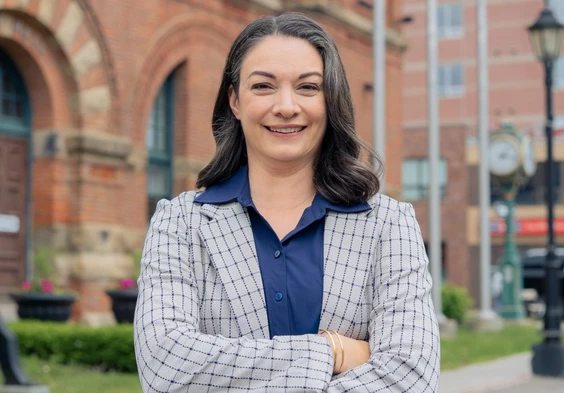
Photo of Amir Zuccolo

Amir Zuccolo

Mayoral Candidate

Amir moved to Prince Edward Island in 2012 after completing a PhD in Chemistry. In 2016, she co-founded AffinityImmuno, a biotechnology company that provided research tools during the COVID-19 pandemic and continues to sell specialty products internationally.

She previously served as a councillor in the Rural Municipality of Brackley, where she spearheaded the installation of solar panels and EV charging stations at the Brackley Community Centre, drafted policy allowing the municipality to fly the Pride flag for the first time, and led Canada Day celebrations.

During her time on council, Amir was involved in the municipal response to COVID-19 and Hurricane Fiona. During the pandemic, she initiated outreach to residents to help ensure they had access to necessities such as groceries and prescriptions. Following Fiona, she went door to door checking on residents. She was awarded a COVID Warrior Coin for her work during the pandemic response.

Amir has also been active in cycling, active transportation, revenue diversification and social entrepreneurship.

Visit campaign website

All responses

Question 1

As Charlottetown continues to grow, what do you believe the City needs to do to ensure that fire protection and emergency response capabilities keep pace with that growth?

The City needs to listen to the needs of firefighters directly from the frontline workers (Chief, career firefighters and volunteers) and respond in a timely manner.  There have been delays on the request for a new station which has resulted in an increase in the cost to build due to inflation resulting from the pandemic and now a tariff war with the US.  Delays are increasing the cost to build. 

The current official plan doesn’t mention firefighting infrastructure nor does it take into account firefighting coverage in determining where the development should take place.

There was a location by the CAT dealership that was bought to house the new firehall but it is not specifically laid out in the new official plan.  Mayor Brown has mentioned other uses for this land if it does become surplus. A concern I have about the location of that firehall is the current state of John Yeo Drive which is a private road and is not maintained by the city. This road would be a critical through way for the hall because it would give it a second exit which would be particularly critical in heavy traffic flow on Malpeque road.

Question 2

If the City is able to forecast population growth and plan for increased development density, should it also be forecasting the corresponding fire-service requirements? What information and analysis should the City have to determine what fire-service capacity Charlottetown will need over the next 5–10 years?

The official plan needs to include a plan for fire and other emergency services both in terms of infrastructure and resources (human, trucks, equipment).  The official plan should have a mandatory review every five years and a new plan every 10 years to keep pace with the growing needs of the city including fire service.  The capacity needs to consider population, density growth and geographical footprint.  There should also be a traffic study done on major emergency routes to ensure that emergency vehicles can pass safely, especially on roads where there can be soft shoulders and ditches and minimal space to pull over.  We know that the growth in calls does not have a linear correlation with population growth as we have seen an increase of 42% in calls between 2020 and 2024 with more false alarms in newer buildings. Additionally as the population grows and ages, we will see more medical emergencies and our health care system is currently failing so an undue burden will be placed on firefighters.

Question 3

Charlottetown is considering changes to its development regulations that could allow for increased density, accessory dwelling units, taller and more complex structures, and continued commercial and industrial growth. Do you believe the City's current approach to planning and approving development adequately considers the capacity of municipal services, including fire protection and emergency response? Why or why not? How should the City ensure that fire protection and emergency response capabilities keep pace with the type, scale and location of development being approved?
Do you believe fire-service capacity should be explicitly incorporated into the City's growth and development planning process? If so, how?

No, I don’t believe that the City’s current approach to planning and development adequately considers the capacity of municipal services.  We can see this in other areas as well including parking where we have failed infrastructure. We need to ensure that firefighters get to calls on time and also have access to the water supply/pressure and equipment (hoses and ladders) that they need to access taller buildings.  We also need to ensure that firefighters have adequate training for larger structure fires.  When it comes to the accessory dwelling units, we need to ensure that they are built with proper egress. 

Yes, this is how we ensure we keep pace with growth.  If we were to adopt a mandatory five year review and ten year full update, then we could analyze what capacity of the fire service looks like for the next five and ten years and if it is aligned with the plan.

Question 4

How should the City approach long-term fire department staffing and workforce planning?

We need to ensure that there is adequate succession planning and that the profession remains attractive to young people (pay, respect, working conditions, adequate time off, benefits, counselling services for those who experience trauma through the job).  We need to consider recruitment for career firefighters from the volunteer force.  We need to have a long-term budget cycle rather than year to year.

Question 5

Charlottetown relies heavily on volunteer firefighters to provide emergency response. As the city grows and the demands placed on the fire service continue to increase, do you believe the current balance between career and volunteer firefighters is sustainable?
How should the City determine whether its existing career and volunteer staffing model has sufficient capacity to meet current and future demand?

No, it is not sustainable.  There is a risk of burnout when calls/year exceed 300 and the last publicly available number was 400 at Station 2 which is entirely reliant on volunteers.  We need to understand the current composition of the volunteer force (age, experience) so that we have adequate succession planning and we need to estimate attrition vs new recruitment trends so that we ensure that the volunteer force remains staffed.  We don’t want to run the risk of having a large portion of our experienced volunteer force exit all at once due to age without having people coming through the ranks to replace them.

Question 6

Operational decisions belong to the Fire Chief and professional staff. What do you believe the mayor and City Council's responsibility is when the Fire Chief tells Council that the department requires additional resources?
How would you balance professional advice from the Fire Chief with financial constraints and other competing municipal priorities?

We need to prioritize essential services over nice-to-haves. If this means the city lacks the financial resources, new revenues must be considered to ensure adequately funded emergency and other essential services.

Question 7

If you were presented with evidence that the fire service required significant additional investment, how would you determine whether those investments should take priority over other City projects?
What information or analysis would you want to see before making that decision?

I would need to see the Fire Underwriters Survey assessment.  I think that investment in essential services takes priority over other investments.  I would want to see a breakdown of calls and determine if there is anything that we could proactively do to reduce the pressure of calls (false alarms).  I would like to see a heat map of where the most calls are coming from to ensure that the investment is being made at the right location.

Question 8

The Fire Underwriters Survey assessment is expected to provide recommendations concerning Charlottetown's fire protection capabilities, including the distribution and staffing of fire stations. How should the City use that type of professional assessment when making long-term decisions about the fire department?
Would you view such recommendations as a target the City should work toward, one factor among many, or something else?

I think that the City should use that professional assessment along with data from recent years, first hand accounts of the experience of the chief, platoon chiefs, career firefighters and volunteer firefighters and accounts of other emergency services to make long term decisions.

Question 10

Imagine that you are elected mayor and are sitting down with the Fire Chief for your first detailed briefing on the future of the Charlottetown Fire Department. What is the first question you would ask the Fire Chief, and why?

I would ask them what their experience has been so far on the job and what are the major changes they have observed in their time in the role.  I would ask what the City could best do to support the department into the future.  I am not nor have I ever been a firefighter so I don't have expertise in this area. I would want to listen to voices with that expertise so that the City makes the best possible decisions for the firefighters and public safety.